
The rupee has fallen more than 2 per cent against the dollar since the yuan devaluation

The association demanded that the interest rates for developers as well as home buyers should be brought down to boost realty sector, which is facing a slowdown in demand.

Asian emerging market stock prices did see a bounce post Fed-talk.

'Gold could benefit from the resulting risk aversion, as happened last year.'

The economy is likely to grow at about 5.6 per cent in 2014-15 and fiscal and current account deficits no longer pose a threat to macroeconomic stability, India Ratings said on Friday.

The 50-stock NSE barometer Nifty finished 14.75 points, or 0.14 per cent, down at 10,382.70 after shuttling between 10,340.65 and 10,393.15.

BofA-ML said the liquidity deficit is running higher than the forecasts because the RBI has suspended its bond buybacks or open market operations.

Apart from being the most successful cases under the IBC, Bhushan Steel and Essar Steel are among the best steel assets in the country. They also ended up helping their lenders get back a significant chunk of the money while allowing Tata Steel to consolidate its position and giving the world's two largest steel makers - ArcelorMittal and Nippon Steel - a strong foothold in India. A significant contrast was the pace at which these two cases were resolved under the bankruptcy code. In the annals of the Insolvency and Bankruptcy Code (IBC), Essar Steel may go down in history as the most noticeable resolution with the world's largest steelmaker, ArcelorMittal, and the incumbent, Ruia family, locked in an intense battle spanning more than two years and ultimately resulting in full recovery of the principal amount for the financial creditors.

Indian corporates might face higher borrowing cost in the overseas market in short-run due to the Greek debt crisis.

Indian investments in equity and debt account for the second-highest remittances outgo (about a quarter).

The Reserve Bank in its first mid-quarter policy review on Monday kept the key interest rates unchanged because of elevated food inflation, rupee depreciation and uncertainty over foreign fund inflows.

Falling for the fourth day in succession, the rupee today dipped by 23 paise to close at nearly three-week low of 59.38 against the dollar amidst the RBI announcing an SLR cut that is expected to release nearly Rs 40,000 crore into markets.

US interest rate normalisation policy is likely to keep global FX markets volatile.

In dollar terms, the Indian markets managed to climb back to 2008 levels only in January this year. The subsequent fall in the rupee because of emerging market woes has once again pushed the markets below their 2008 level in dollar terms.

Top losers in the Sensex pack included TCS, Yes Bank, ITC, Sun Pharma, Reliance, Coal India, Asian Paints, SBI, Maruti, HUL, HCL Tech and ICICI Bank, falling up to 2.91 per cent.
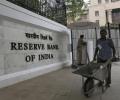
While RBI's foreign exchange reserves have swelled to over $400 billion, it has a 'sell' position of $981 billion.

Indian capital markets joined the global sell-off sparked by China growth concerns

The Malegam committee on the RBI's capital adequacy had suggested that the RBI must move away from its methodology to calculate the foreign exchange gains to a weighted average cost-based valuation method. Central bank may done away with provisioning requirements, to enable higher transfer of surplus in the 2017-18 fiscal, analysts say.

Bajaj Finance was the biggest loser in the Sensex pack, tanking up to 8 per cent, followed by Hero MotoCorp, IndusInd Bank, Maruti and HCL Tech. Axis Bank, ITC, NTPC and M&M were among the top gainers.

The minister further said the rupee will regain the ground it lost against other currencies in the past few days.


Mandatory hallmarking of gold would be a positive in making the gold market more organised. Mandatory hallmarking would come into effect from January 15, 2020, with a one-year transition period for trade to sell existing inventories. Experts also expect more policy measures next year to bring in more transparency in terms of gold as an asset class.

The rupee has been falling for five straight weeks, taking its losses this quarter to 6.6 per cent, making it the worst performing currencies in Asia during this period.

As FY20 Budget fiscal measures need to be better understood, a reversal of the stance back to neutral will allow MPC flexibility to respond to incoming data.

The immediate concern for the rupee is the sharp spike in oil prices

10 stocks which are most popular with brokerages right now and are expected to deliver maximum upside over the next 12 months.

A massive outflows of foreign funds on the back of stricter participatory notes and renewed possibility of Fed lifting US interest rates largely impacted the domestic unit.

Textile exports are expected to reach $50 billion by 2014-15 on the back of new markets.

'So far as supervision is concerned, there are enough powers but to take action on public sector banks, consultation with the government is needed.'

Both the indices closed at five-month highs, led by financial services, IT and metal stocks, amid persistent foreign fund inflows.

Brokerage firm Bank of America Merrill Lynch (BofA-ML) on Monday said the ongoing US government shutdown is positive for the country, as it gives additional time to recoup the forex reserves.

India Ratings expects long products demand growth to be sharp, supported by a demand push from the government-led infrastructure investments in affordable housing, railways, rural electrification and road networks.

India needs to sustain a GDP growth rate of 8 per cent to become a five trillion dollar economy by 2025, the Economic Survey has stated.
It can be noted that the rupee lost nearly 7 per cent since the beginning of May as FIIs have pulled out nearly $4 billion from the domestic debt, as bond yields fell on expectation of RBI cutting rates on Monday.

An expected withdrawal of FIIs from the market likely to weaken the rupee against the dollar.

'Macro headwinds are rising for Indian equities in the form of rising commodity prices, especially oil, depreciating rupee, fiscal challenges, election-related uncertainty and upside risks to inflation'

Investors prefer exits with lower valuation to staying invested for a longer term

'Life will not improve overnight; it will happen in a gradual manner.'

Year-to-date, the rupee is the worst-performing currency in Asia, weakening 4.184 per cent against the US dollar.

Research and ratings agencies like Icra and Moody's have said the CAD in 2018-19 would be much higher than 2017-18
